
SURAH AL KAHF (THE CAVE): AYAT 96 (QURAN 18:96)
From the dawn of civilization, two metals have shaped the human story more profoundly than any others: iron and copper. Their properties, their chemistry, and their role in technological evolution form a narrative that stretches from ancient furnaces to modern laboratories — and remarkably, this narrative appears with striking precision in the Qur’an’s account of Dhul‑Qarnayn (pbuh) in Surah al‑Kahf (18:96).
Dhul‑Qarnayn (pbuh) emerges in the Qur’an as a figure of righteous power, a traveler‑king whose authority is matched by humility and justice. The narrative in Surah al‑Kahf portrays him journeying to the far reaches of the earth, not in conquest but in service — uplifting oppressed communities, restoring balance, and using knowledge responsibly. His most striking episode is the construction of a colossal barrier between two mountains, built to protect a vulnerable people from the ravages of Ya’juj and Ma’juj (Gog and Magog). The Qur’an presents him as a model of leadership rooted in wisdom: a ruler who recognizes that true strength lies not in dominion, but in aligning one’s actions with divine guidance.
Copper — Humanity’s First Companion in Metal
Archaeologists widely recognize copper as the earliest metal worked by humans, owing to its naturally occurring metallic form and low melting point. Its scientific profile is extraordinary: copper possesses exceptional electrical conductivity (NIST), thermal conductivity (Thermopedia), and corrosion resistance, making it indispensable in modern engineering.
In contemporary powder metallurgy (ASM International), copper powders are compacted and sintered to create components with tailored mechanical properties. Copper also plays a crucial role in modifying iron‑based alloys (Copper Development Association), enhancing strength, density, and wear resistance.
Iron — The Metal That Built the Modern World
If copper began the story, iron transformed it. Iron’s abundance and its ability to form steel through controlled carbon addition underpin nearly every modern structure. The science of metallurgy — the study of the physical and chemical behavior of metals and alloys — is foundational to understanding how iron can be hardened, tempered, and alloyed. Authoritative metallurgical frameworks are detailed by institutions such as MIT Materials Science (MIT MSE).
Iron’s role in powder metallurgy is equally central: iron powders are blended with copper or graphite to create high‑performance components used in automotive, aerospace, and industrial applications.
The Qur’anic Insight: Iron First, Then Molten Copper
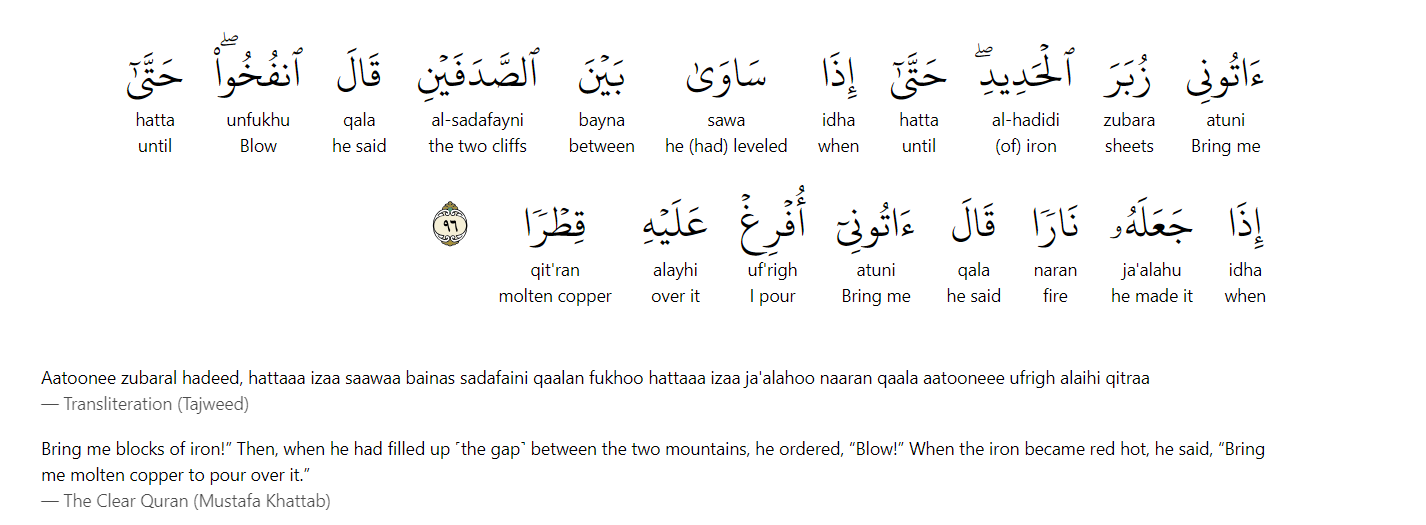
Surah al‑Kahf describes Dhul‑Qarnayn constructing a massive barrier using iron blocks, then commanding: “Bring me molten copper to pour over it.”
(Qur’an 18:96)
This sequence is scientifically remarkable.
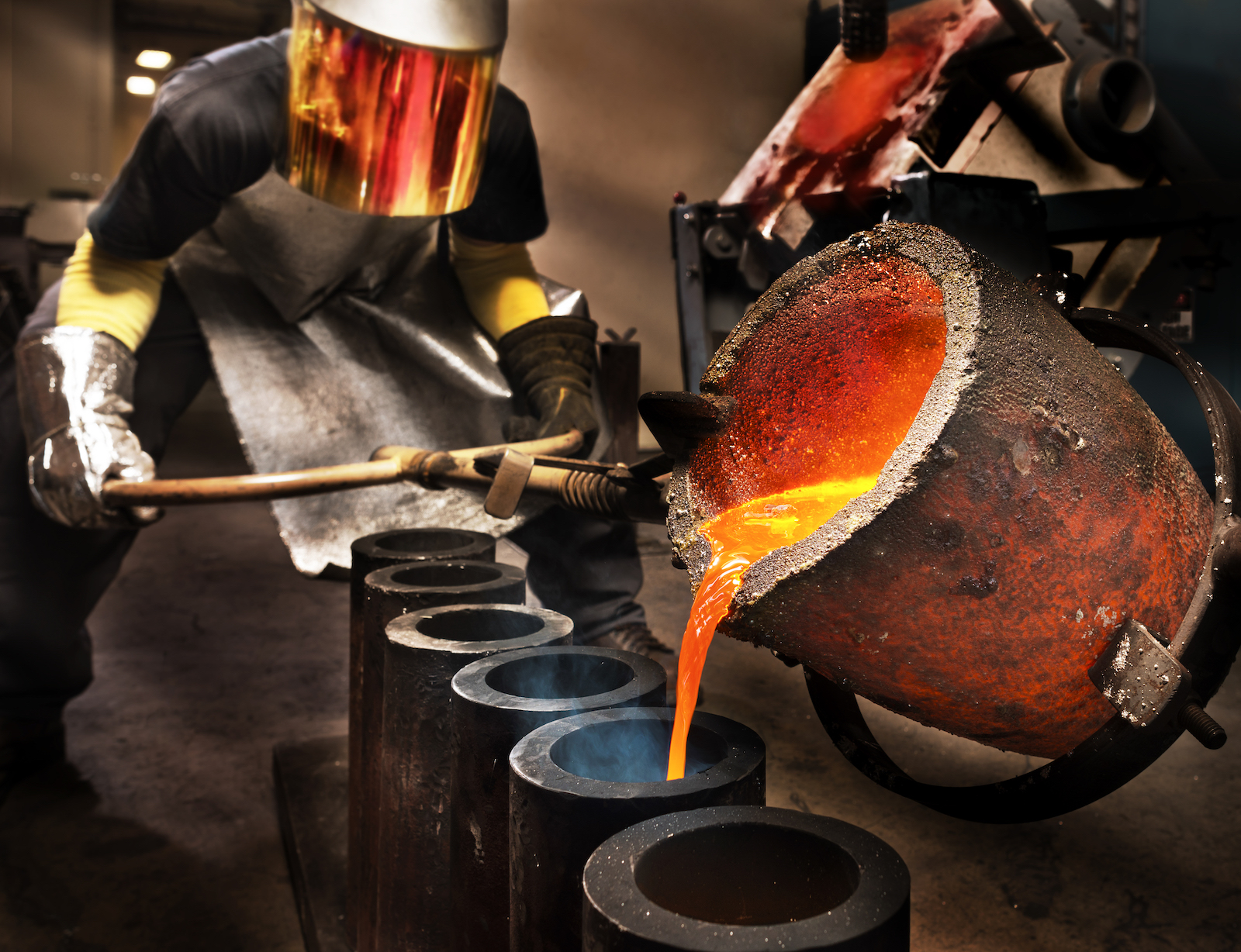
Modern materials engineering shows that pouring molten copper over an iron structure creates a metal matrix composite (ScienceDirect). The iron provides structural strength, while the copper infiltrates gaps, reduces porosity, and forms a corrosion‑resistant seal — a process strikingly similar to liquid metal infiltration used in advanced composite fabrication (Wiley Materials Science).
Even more astonishing is that this method aligns with principles of:
- Thermal bonding between dissimilar metals
- Corrosion science and protective metal coatings
- Cu–Fe diffusion behavior (Journal of Materials Research)
- Infiltrated iron–copper systems used in modern engineering
The Qur’anic description mirrors these metallurgical realities with uncanny precision — despite being revealed in the 7th century, long before the scientific understanding of phase diagrams, diffusion kinetics, or composite engineering.
Where Revelation and Metallurgy Converge
The verse does not merely list two metals; it describes a process that aligns with:
- Powder metallurgy infiltration techniques
- Composite material engineering
- Corrosion‑resistant barrier construction
- Thermomechanical treatment of Cu–Fe systems
This convergence of ancient scripture and modern materials science is a moment of profound reflection — a reminder that the Qur’an often speaks in imagery that resonates with truths uncovered centuries later. Surah al‑Kahf’s metallurgical detail stands as one of these resonances: an elegant intersection of revelation, engineering, and the timeless human quest to understand the materials that shape our world.