
SURAH FUSSILAT (“EXPLAINED IN DETAIL”): AYAT 9-11 (QURAN 9:11)
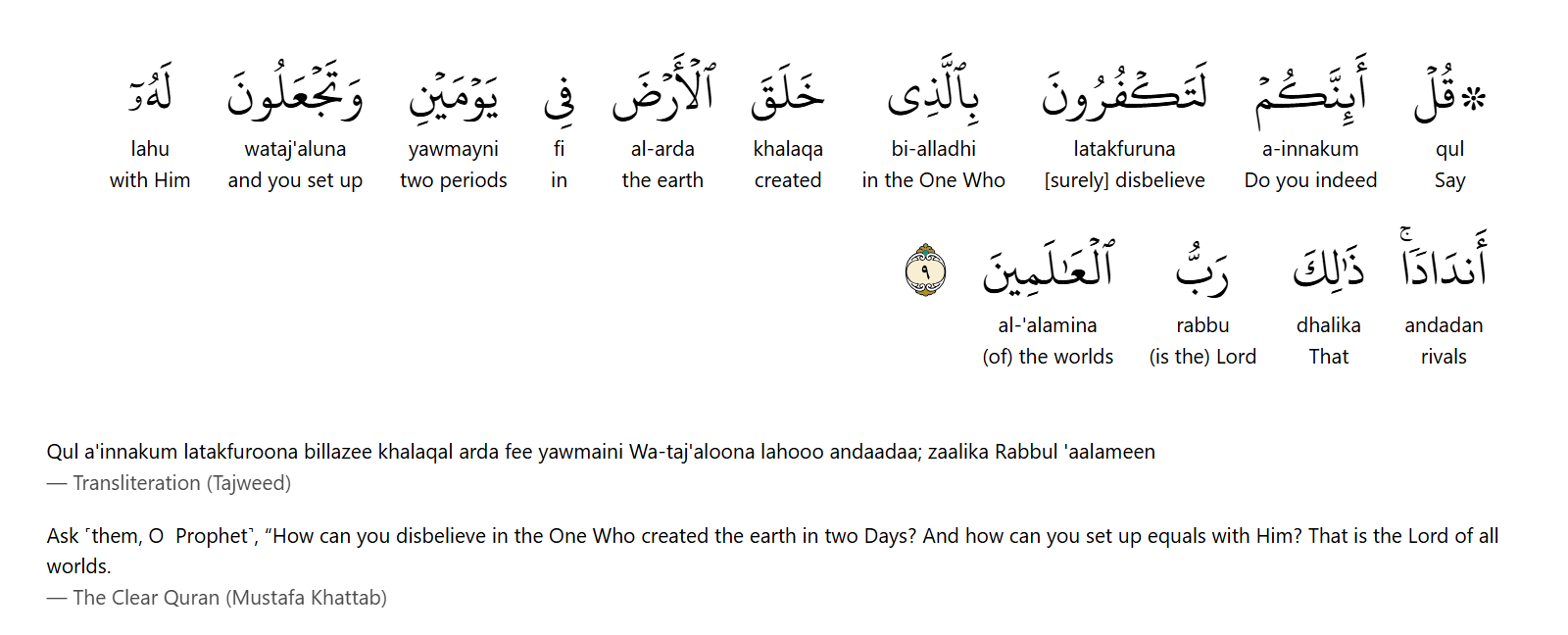
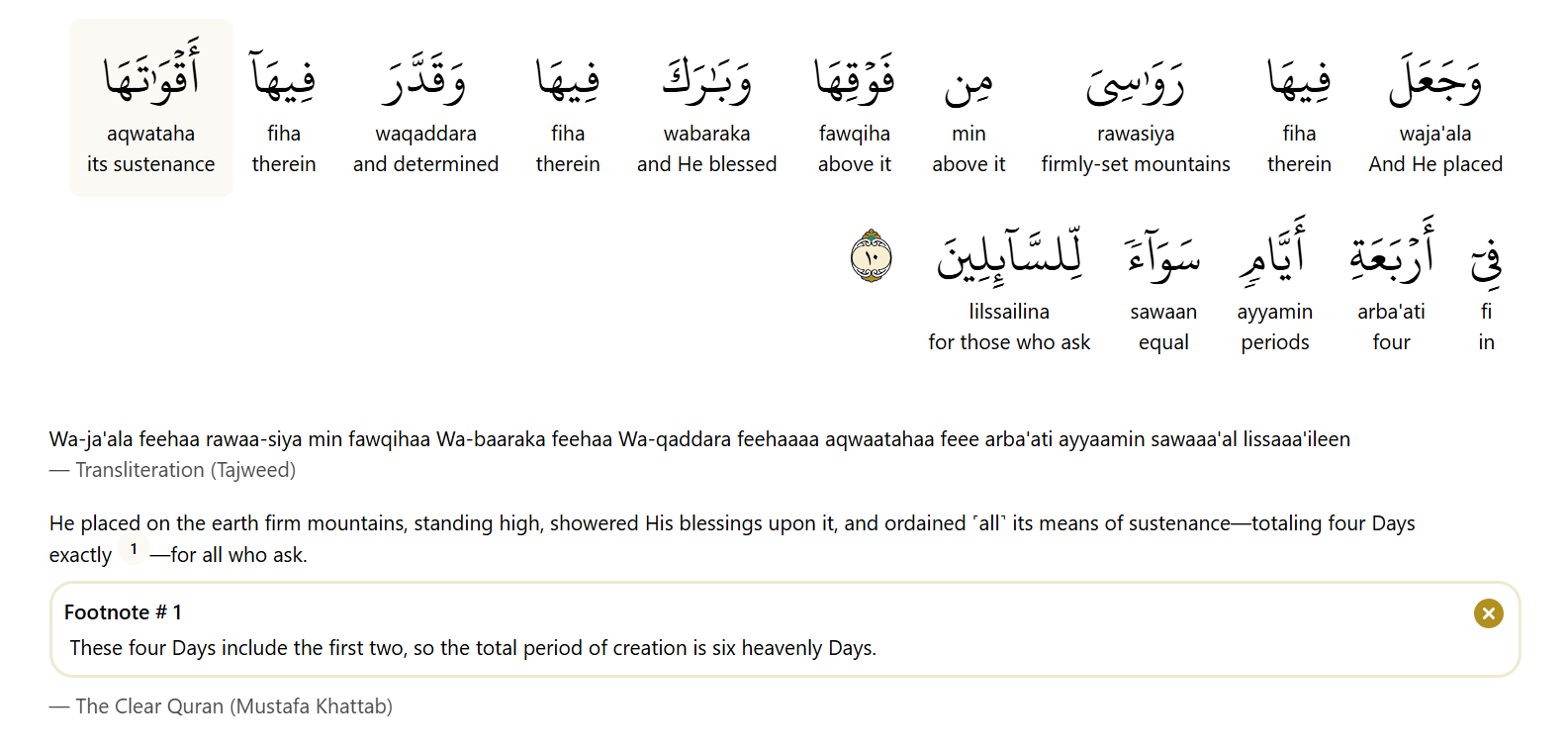
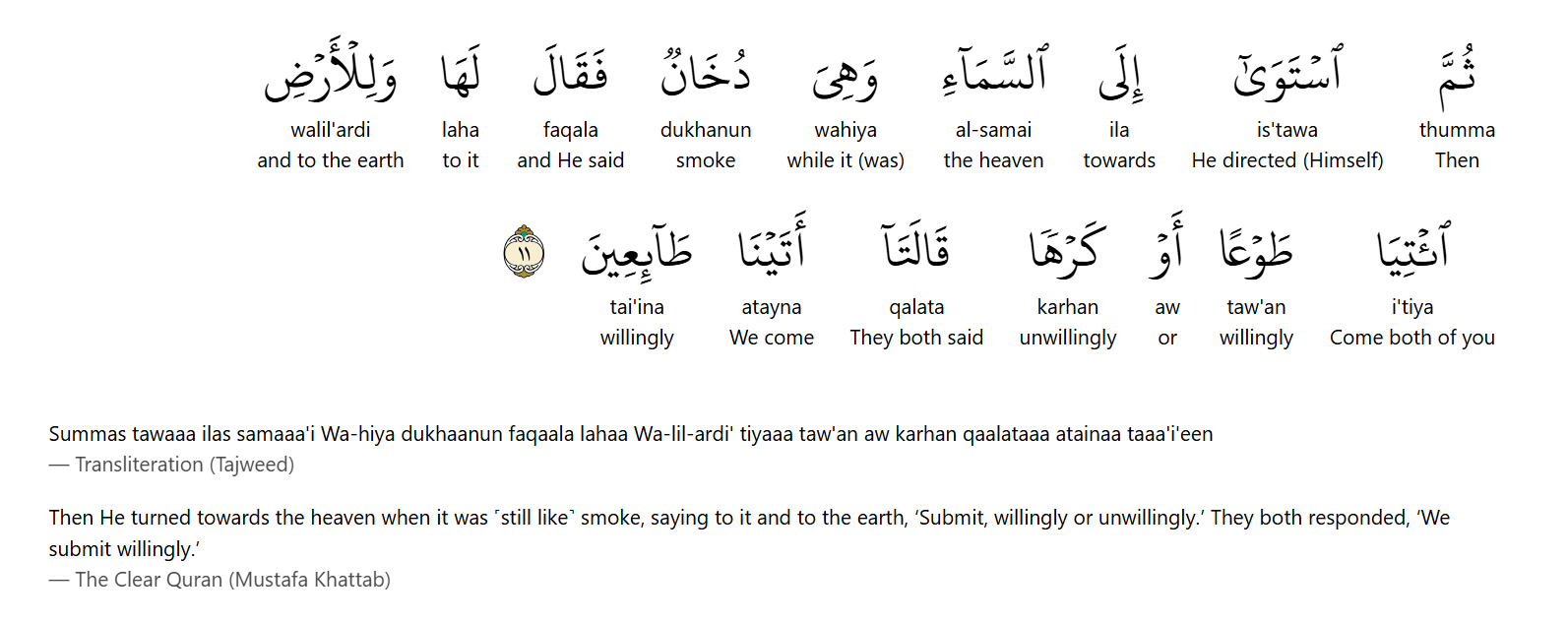
The Qur’an often invites readers to contemplate the heavens—not as a scientific manual, but as a text that provokes wonder, humility, and reflection. The Qur’an’s cosmological language has long invited scholarly engagement, particularly where its descriptions of creation intersect with contemporary scientific models.Among its most striking cosmological verses are those describing the creation of the universe in six “days” (periods or epochs) and the formation of the Earth in two:
“Say, do you indeed disbelieve in He who created the earth in two days… Then He turned to the heaven when it was smoke and said to it and to the earth, ‘Come willingly or unwillingly,’ and they said, ‘We come willingly.’ And He completed them as seven heavens in six days…”
— Qur’an 41:9–12
While classical scholars emphasize that “days” here refer to divine phases rather than 24‑hour intervals, the proportionality—Earth: 2 units, Universe: 6 units—is unmistakable.
🌍 A Striking Parallel in Modern Cosmology
Modern astrophysics estimates:
- Age of the Universe: ~13.8 billion years
(NASA and cosmology consensus) - Age of the Earth: ~4.54 billion years
(Radiometric dating evidence from the International Planetarium Society)

In other words, the universe is roughly three times older than the Earth—a ratio astonishingly close to the Qur’anic 6:2 (also 3:1).
The Qur’an does not claim to offer a physics textbook. It is essential to note that the Qur’an does not claim to provide numerical cosmology. Nonetheless, the proportionality between the Qur’anic creation stages and the scientific chronology is academically noteworthy for several reasons:
- The Qur’anic description of the early heavens as “smoke” parallels the scientific understanding of the early universe as a hot, dense plasma (wmap.gsfc.nasa.gov).
- The sequential structure—Earth’s formation preceding the completion of the heavens—echoes the astrophysical reality that planetary systems form long after the Big Bang, during later stages of stellar evolution (science.nasa.gov).
- The ratio itself, while not a scientific claim, provides a conceptual bridge between scriptural cosmology and empirical chronology.
These parallels do not imply scientific prediction; rather, they highlight the Qur’an’s capacity to engage readers across intellectual contexts, including those informed by modern astrophysics.
🌱 A Universe That Invites Reflection
The Qur’an repeatedly urges humans to “look again and yet again” at the heavens (67:3–4). Today, with telescopes peering billions of years into the past and geology uncovering Earth’s deep history, that invitation feels more alive than ever.
The harmony between the Qur’an’s symbolic creation framework and the scientific ratio of cosmic ages offers a poetic bridge between faith and reason. It reminds us that the pursuit of knowledge—whether spiritual or scientific—is ultimately a journey toward understanding our place in a vast, finely balanced universe. And as modern science elucidates more light upon creation – it is imperative to anyone with reason that the Quran nearly 1500 years ago was from the One – THE Creator.